
How to Start an Accountability Partnership in 7 Days
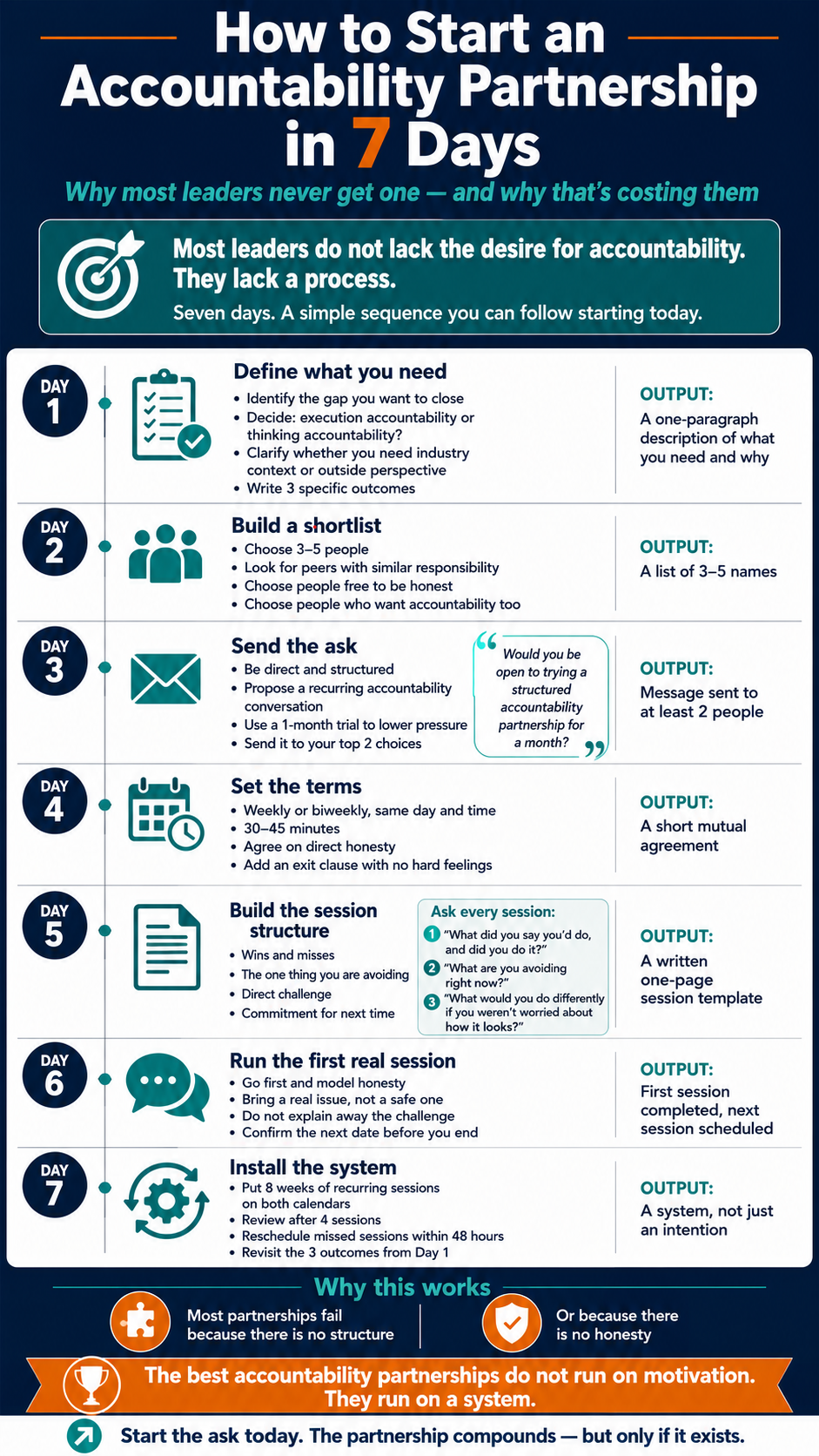
How to Start an Accountability Partnership in 7 Days
Why most leaders never get one (and why that's costing them)
Most leaders don't lack the desire for accountability. They lack a process.
They know they should have someone challenging their thinking. They just don't know how to set it up without it feeling awkward, forced, or like one more thing added to an already-full calendar.
This is the process. Seven days. No vague advice — a sequence you can actually follow, starting today.
Day 1: Define what you actually need
Before you look for a partner, get honest about the gap you're trying to close. "I need someone to keep me accountable" is too vague to act on.
Ask yourself:
Where do I consistently let myself off the hook?
What decisions do I make with zero outside input right now?
Do I need accountability for execution (hitting targets, finishing projects) or for thinking (decision quality, blind spots, ego checks)?
Do I want someone in my industry who understands the context, or someone outside it who has no stake and no politics?
Write down three specific outcomes you want from this partnership. "Be more disciplined" is not specific. "Have someone ask me every week whether I actually made the call I said I'd make" is specific.
Output of Day 1: A one-paragraph description of what you need and why.
Day 2: Build a shortlist of three to five people
You're not looking for a friend. You're not looking for a fan. You're looking for someone who meets three criteria:
They operate at a comparable level of responsibility. A peer accountability partnership works best between people carrying similar weight — another founder, another senior leader, another person with skin in the game. Power imbalances change what people are willing to say.
They have nothing to lose by being honest with you. No reporting line, no financial dependency, no fear of your reaction costing them something.
They actually want this too. One-sided accountability isn't a partnership — it's unpaid coaching, and it won't last.
Good sources for candidates: people in mastermind groups, founder communities, former colleagues now at a similar level elsewhere, or peers you've met at conferences who you respected but never followed up with.
Output of Day 2: A list of 3–5 names.
Day 3: Send the ask (use this exact framing)
Most accountability partnerships never start because the ask is mushy — "we should catch up more" leads nowhere. Be direct about what you're proposing.
A message that works:
"I've been thinking about setting up a structured accountability partnership — a recurring conversation where we each bring one decision or challenge we're avoiding, and push each other on it. Not a casual catch-up, something with real structure. Would you be open to trying it for a month and seeing if it's useful?"
Notice what this does:
Names the format clearly
Removes pressure with a trial period ("a month")
Signals you're serious, not just looking for company
Send this to your top two choices on Day 3. Don't wait for the perfect moment — the ask itself filters for the right partner. People who are serious about their own growth respond fast.
Output of Day 3: Message sent to at least two people.
Day 4: Set the terms before the first meeting
Once someone says yes, don't jump straight into "let's just talk." Define the operating rules first — this is the single biggest predictor of whether a partnership lasts past month one.
Agree on:
Frequency: Weekly or biweekly, same day and time, recurring on the calendar (not "whenever we're free")
Length: 30–45 minutes. Long enough for substance, short enough to actually happen consistently
Format: What each session covers — see Day 5
The honesty clause: Explicit permission to challenge each other directly, without it being treated as personal. Say this out loud: "I want you to push back on me, even if it's uncomfortable."
An exit clause: Agree upfront that either person can end it with no hard feelings if it's not working. This makes people more willing to start.
Output of Day 4: A short, mutual agreement — even a two-line text confirming the terms counts.
Day 5: Build the actual session structure
A partnership without structure drifts into venting. Use a simple recurring format:
Wins and misses since last time (5 min) — what happened, what didn't
The one thing you're avoiding (10–15 min) — the decision, conversation, or action each person has been putting off. This is the core of the session.
Direct challenge (10 min) — the partner asks the hard question: "Why haven't you done this yet?" "What are you actually afraid of here?" "Is this really the priority, or is it comfortable?"
Commitment for next time (5 min) — one specific, named action each person commits to before the next session
Three questions worth using every single session:
What did you say you'd do, and did you do it?
What are you avoiding right now?
What would you do differently if you weren't worried about how it looks?
Output of Day 5: A written one-page session template you both agree to use.
Day 6: Run the first real session
This is the session that determines whether the partnership survives. Two things matter most:
Go first. If you want honesty, model it. Bring something real — not your safest problem, your actual one.
Resist the urge to explain away the challenge. When your partner pushes back, the instinct is to justify. Don't. Sit with it for a second before responding.
End the session by confirming the next date on the spot. Partnerships die in the gap between "let's do this again sometime" and an actual date on the calendar.
Output of Day 6: First session completed, next session scheduled.
Day 7: Install the system so it survives week three
Most accountability partnerships don't fail in week one — they fail in week three or four, once the novelty wears off. Protect against this now:
Put recurring sessions on both calendars for the next 8 weeks, not just the next one
Agree on a check-in point — after 4 sessions, spend 5 minutes asking "is this actually working for both of us?"
Decide how you'll handle a missed session in advance (reschedule within 48 hours, never just skip)
Write down the three outcomes from Day 1 somewhere you'll both see again in a month, so you can measure against them honestly
Output of Day 7: A system, not just an intention. Eight sessions on the calendar, a review point set, and clear rules for what happens when life gets in the way.
The real reason this works
Accountability partnerships fail for one of two reasons: no structure, or no honesty. The seven-day process above forces both — you can't skip the terms-setting and you can't skip naming what you're avoiding.
The leaders who build the most durable version of this don't wait for motivation to keep going. They built a system on day one that doesn't depend on motivation at all.
Start the ask today. The partnership compounds — but only if it exists.


Comments